§ N° II · Research
The CJC-1295 Research Record
Mechanism, pharmacokinetics, Phase I outcomes, and what the compounding-pharmacy literature claims beyond them.
CJC-1295 Mechanism of Action
The CJC-1295 mechanism of action is GHRH-receptor agonism on anterior-pituitary somatotrophs. The molecule binds the growth hormone-releasing hormone receptor (GHRHR) — a class B G-protein-coupled receptor — and activates the canonical Gs / adenylate cyclase / cAMP / PKA signaling cascade [7]. PKA phosphorylates CREB, which cooperates with the somatotroph-lineage transcription factor Pit-1 to drive growth-hormone gene transcription and release [7].
Cryo-EM structural work in 2020 mapped the activated GHRHR binding interface, confirming the two-domain architecture characteristic of class B GPCRs and clarifying the binding pocket engaged by GHRH(1-29)-derived analogs including CJC-1295 [8]. The downstream consequence is elevated growth-hormone secretion, which in turn drives hepatic IGF-1 production [1].
The DAC variant's distinguishing pharmacology is not at the receptor. CJC-1295 with DAC binds GHRHR with the same affinity as the unconjugated peptide; the difference is residence time in circulation. The maleimidopropionic-acid linker reacts with free thiol cysteine-34 on serum albumin within minutes of subcutaneous injection [4], producing a covalent albumin-peptide bioconjugate that resists renal clearance. The receptor sees more of the drug, for longer, at lower instantaneous concentrations.
CJC-1295 with DAC vs. CJC-1295 without DAC
The single most consequential structural distinction in the CJC-1295 literature is whether the DAC linker is present. The CJC-1295 DAC variant — sometimes notated DAC:GRF — carries the maleimide-modified linker and conjugates to serum albumin; the no-DAC variant — chemically identical to modified GRF (1-29) — does not [12].
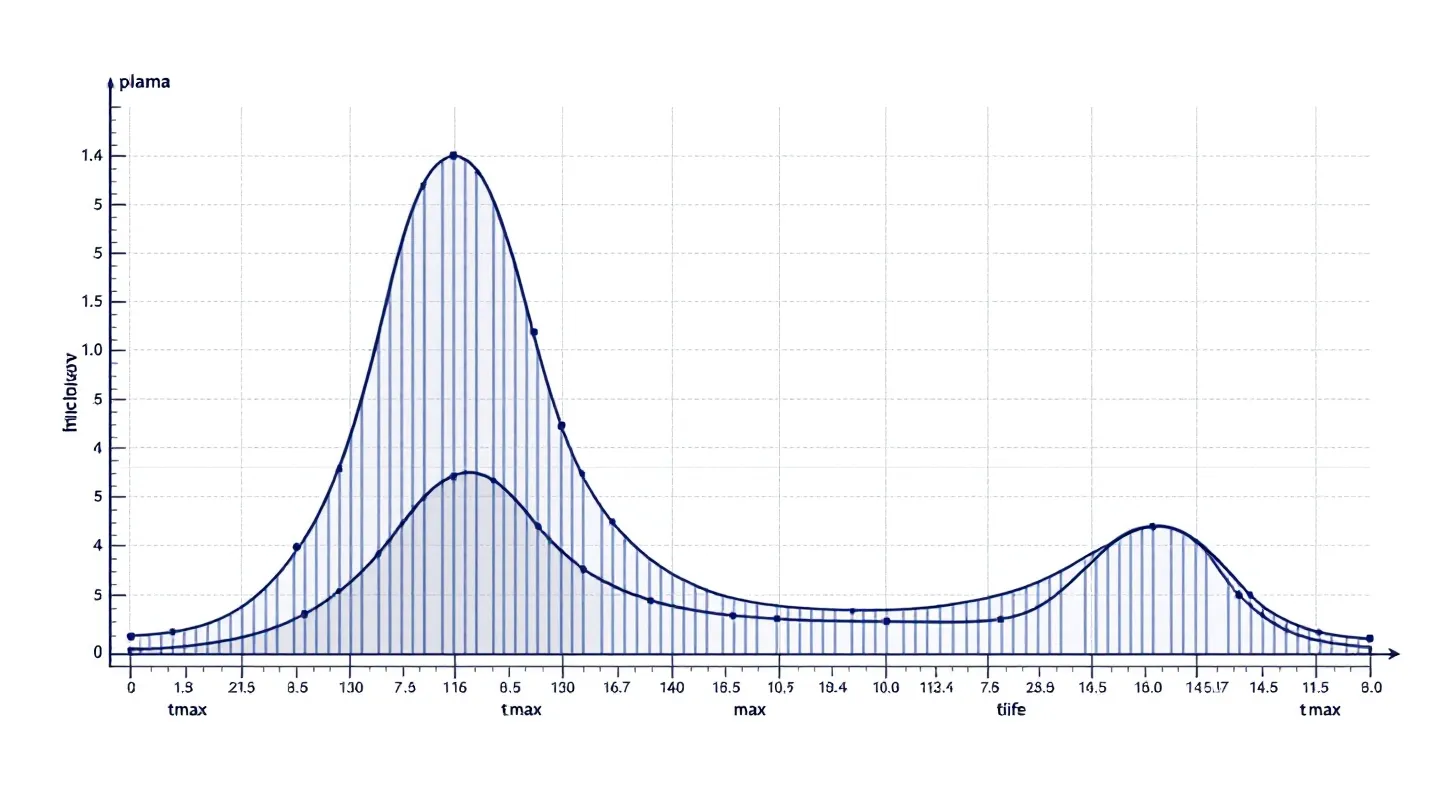
The pharmacokinetic gap is large. With DAC: plasma elimination half-life of 5.8 to 8.1 days in healthy human Phase I subjects [2], cumulative IGF-1 elevation above baseline for up to twenty-eight days after repeat dosing [2], detection of the albumin-bound peptide in rat plasma beyond seventy-two hours after a single dose [4]. Without DAC: approximately thirty minutes [12].
The consequence for dosing logic — peer-reviewed or gray-literature — is direct. The DAC variant supports weekly subcutaneous dosing because the receptor remains occupied between doses. The no-DAC variant requires multiple daily doses to maintain any sustained GH-axis effect, which is why compounding-pharmacy protocols using 'CJC-1295 without DAC' typically prescribe one to three injections per day [12]. Anyone reading 'CJC-1295' without a specified DAC status is reading about two different drugs at once.
CJC-1295 without DAC (modified GRF 1-29)
CJC-1295 no DAC is functionally indistinguishable from modified GRF (1-29). Both names refer to tetrasubstituted GHRH(1-29) without the albumin-binding linker: D-Ala at position 2, Gln at position 8, Ala at position 15, Leu at position 27 [12]. The substitutions confer DPP-IV resistance but do not extend half-life beyond the order of thirty minutes [12].
Modified GRF (1-29) — the no-DAC parent molecule
Modified GRF 1-29 is the chemistry-literature name for the no-DAC parent. It is the molecule that ConjuChem started with and the DAC linker was added to. The two names persist in parallel because the peptide-research community adopted 'modified GRF (1-29)' while the compounding-pharmacy community adopted 'CJC-1295 without DAC.' They are the same compound.
CJC-1295 Half-Life and Pharmacokinetics
CJC-1295 Half-Life and Pharmacokinetics
The CJC-1295 half life is the defining pharmacokinetic property of the molecule, and it splits cleanly along DAC status. CJC-1295 with DAC: 5.8 to 8.1 days in healthy human plasma in the Teichman Phase I trial [2]. CJC-1295 without DAC (modified GRF 1-29): approximately thirty minutes [12]. The DAC variant produces sustained baseline GH elevation; the no-DAC variant produces brief pulses.
The albumin-conjugation kinetics underlie the gap. The maleimide linker reacts with free thiol cysteine-34 on circulating albumin within minutes of subcutaneous injection; the resulting bioconjugate is too large for glomerular filtration and is cleared on the timescale of albumin turnover rather than peptide turnover [4]. Albumin's own half-life in human circulation is roughly nineteen days; CJC-1295-DAC therefore approaches a substantial fraction of that ceiling before falling off [4].
Outcomes Reported in CJC-1295 Studies
The CJC-1295 results that exist in the peer-reviewed literature come almost entirely from the Teichman 2006 Phase I dose-escalation trial in healthy adults [1]. Across single subcutaneous doses of 30, 60, 125, and 250 µg/kg, mean plasma growth hormone rose 2- to 10-fold and remained elevated for six days or more; mean plasma IGF-1 rose 1.5- to 3-fold and remained elevated for nine to eleven days [1][2]. Repeat dosing every one or two weeks produced cumulative IGF-1 elevation extending to twenty-eight days [2].
The Jetté 2005 rodent characterization measured a 4-fold increase in GH area-under-the-curve over two hours relative to unmodified GRF following intravenous administration in rats, and detection of the albumin-bound peptide in plasma beyond seventy-two hours [4]. The Alba 2006 GHRH-knockout mouse study showed once-daily subcutaneous CJC-1295 normalized body weight, body length, pituitary GH-gene expression, and somatotroph proliferation — less-frequent dosing produced only partial restoration [5].
What the published record does not contain: a powered body-composition trial, a randomized controlled efficacy study, a long-term safety study, a head-to-head against tesamorelin or sermorelin, or any Phase III data. ConjuChem's Phase II HIV-lipodystrophy trial (n = 192) was halted in 2006 after a participant death from myocardial infarction — the death was clinically attributed by the investigator to pre-existing asymptomatic coronary artery disease, but commercial development was discontinued [13].
Reported Effects and Benefits in the Literature
CJC-1295 benefits, in the strict sense the peer-reviewed literature supports, are the pharmacological endpoints measured in published trials: dose-dependent elevation of plasma growth hormone, sustained elevation of plasma IGF-1, and restoration of growth in the GHRH-knockout mouse [1][2][5]. These are pharmacodynamic findings, not clinical outcomes.
The broader claims circulating in compounding-pharmacy and direct-to-consumer literature — fat loss, lean-mass gains, anti-aging effects, deeper sleep, skin and joint improvements — are extrapolations from general growth-hormone pharmacology, not measurements made specifically in a CJC-1295 trial. The class comparator that has been studied: tesamorelin, the only FDA-approved GHRH analog, produced approximately 15-20% reduction in visceral adipose tissue over twenty-six weeks in a 410-patient Phase III trial in HIV-associated lipodystrophy [11][18]. Tesamorelin is structurally adjacent to CJC-1295 but its trial results cannot be assumed to transfer.
What is honest: the GH/IGF-1 axis is downstream of CJC-1295 administration, and the GH/IGF-1 axis is mechanistically associated with lipolysis, protein anabolism, and tissue repair. What is honest as a limit: no published CJC-1295 trial has measured those downstream clinical outcomes.
Reported effects in the body
Reported effects in the body
In published Phase I trials, single doses of CJC-1295 with DAC elevated mean plasma growth hormone 2- to 10-fold and IGF-1 1.5- to 3-fold for six days or longer [1]. Clinical-level body composition data in humans remain limited — Phase I trials were not powered for body-composition endpoints, and no Phase II body-composition trial in healthy populations has been published [1].
Body-composition effects in studies
No CJC-1295 trial has been adequately powered for body-composition endpoints. The mechanistic association between sustained GH/IGF-1 elevation and lipolysis is established in general growth-hormone pharmacology, but CJC-1295-specific human weight-loss data are limited and short-duration. Tesamorelin, the class comparator, reduced visceral adipose tissue ~15-20% over twenty-six weeks at 2 mg/day SC in a Phase III trial [11].
Receptor binding
Receptor binding
GHRH-receptor (GHRHR), a class B G-protein-coupled receptor expressed on anterior-pituitary somatotrophs [7]. Agonist binding activates the Gs / adenylate cyclase / cAMP / PKA pathway, leading to CREB phosphorylation and Pit-1-cooperative transcription of the GH gene [7]. The 2020 cryo-EM structure clarified the binding-pocket architecture engaged by GHRH(1-29)-derived analogs [8].
Effects on IGF-1
Effects on IGF-1
Phase I trials reported sustained 1.5- to 3-fold IGF-1 elevation lasting approximately six to eleven days after a single DAC-variant dose, with cumulative elevation extending to twenty-eight days under repeat-dose protocols [1][2]. IGF-1 is the downstream hepatic mediator of GH action, with an own plasma half-life of roughly twelve to fifteen hours — long enough to integrate GH exposure over hours-to-days, making it the canonical biomarker of GHRH-analog effect.
Modified GRF (1-29)
Modified GRF (1-29)
The chemistry-literature name for CJC-1295 without DAC: GHRH (1-29) with four amino-acid substitutions (D-Ala, Gln, Ala, Leu) that protect against enzymatic degradation but lack the DAC linker [12]. Plasma half-life on the order of thirty minutes; brief, pulsatile growth-hormone effect; not albumin-bound.